


Ethereum Magicians drafts asynchronous NFT ownership projection
Ethereum Magicians are drafting an interface for asynchronous NFT ownership projection, separating immediate transfers from time-indexed historical ownership.

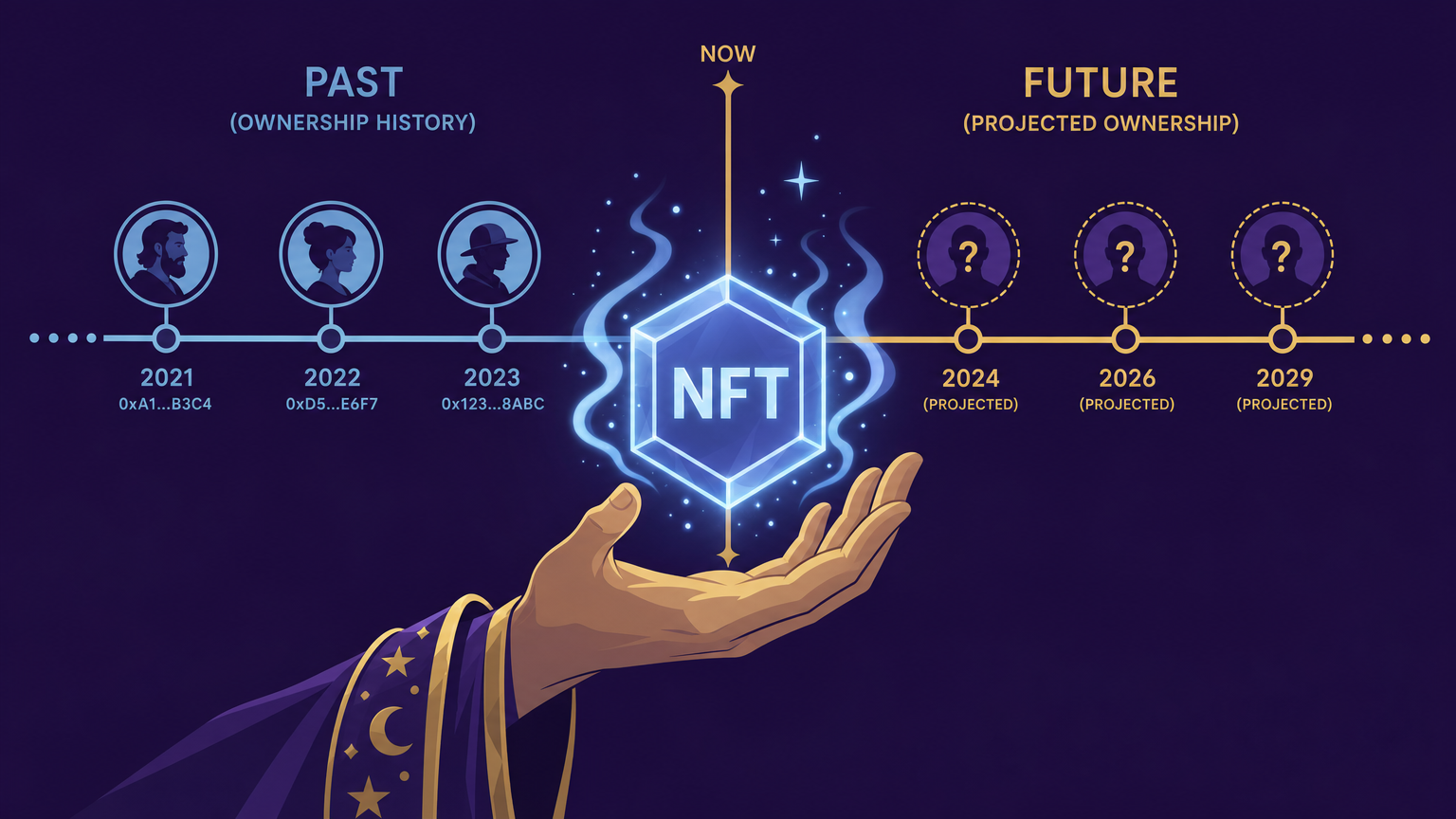
The working draft landed on Ethereum Magicians on September 10, 2026, under the title “Asynchronous Register Projection for NFTs.” It has no ERC number. The author is explicitly holding off on requesting one — the stated priority is getting the “scope and semantics right” before filing a pull request.
It’s framed as a foundational interface discussion, not a numbered revision hunt, with questions about how applications should interpret historical answers, finality, and gaps in a register’s record left deliberately open.
The proposed core interface,IRegisterProjection, exposes seven functions:currentEntry,entryAt,entryCount,entryAsOf,holderAsOf,isFinalAsOf, andregisterId. Its ERC-165 interface identifier is0x6309e170. There’s also an optional settlement interface,IProjectionSettlement, with ERC-165 ID0xf4a7d71b.
The problem the draft is trying to solve is real. ERC-721’sownerOf(tokenId) tells you who holds a token right now. An external register confirming ownership for a specific past instant may update on a different clock — more slowly, or later. Those two states aren’t the same thing.
The proposal’s answer is a time-indexed history of confirmed holders that sits apart from the immediate transfer state. An application needing historical ownership could query the projection for the holder at a given past effective time, then check whether that answer is final. If the external register hasn’t caught up yet, the application gets a provisional answer and has to account for open gaps.
Several implementation questions are still unresolved. Can a strictly increasing effective-time model handle corrections, or multiple changes within a single second? Should projection-only implementations state their admission guarantees separately from settlement? What limits on supersession and future effective times need to be mandatory rather than optional?
For NFT projects, a common contract surface for records that don’t settle at transfer speed would be useful. The desk’s read is that the practical cost falls on integrators: until the semantics are locked, code built on historical ownership should not assume that a returned answer has the same finality as the current holder.
The author says they want to settle the scope and semantics before pushing a pull request for an ERC number.
ETH was trading at $2,455.70, down 1.8% over 24 hours, per CoinGecko. Using the rounded percentage, that implies a previous price of about $2,499.69 and a drop of about $43.99; the draft provides no basis for connecting that move to the proposal.

Marcus Feld
Marcus Feld is CoinScoop's DeFi and on-chain analyst. He digs into L2 activity, stablecoin flows and protocol revenue, translating raw chain data into plain-English calls.