


Aave weighs Coinbase B20 equities as Base collateral
Aave is considering seven Coinbase B20 tokenized equities as collateral for a new Aave V4 Base market, allowing USDC borrowing against them, pending resolution of custody and vesting issues.

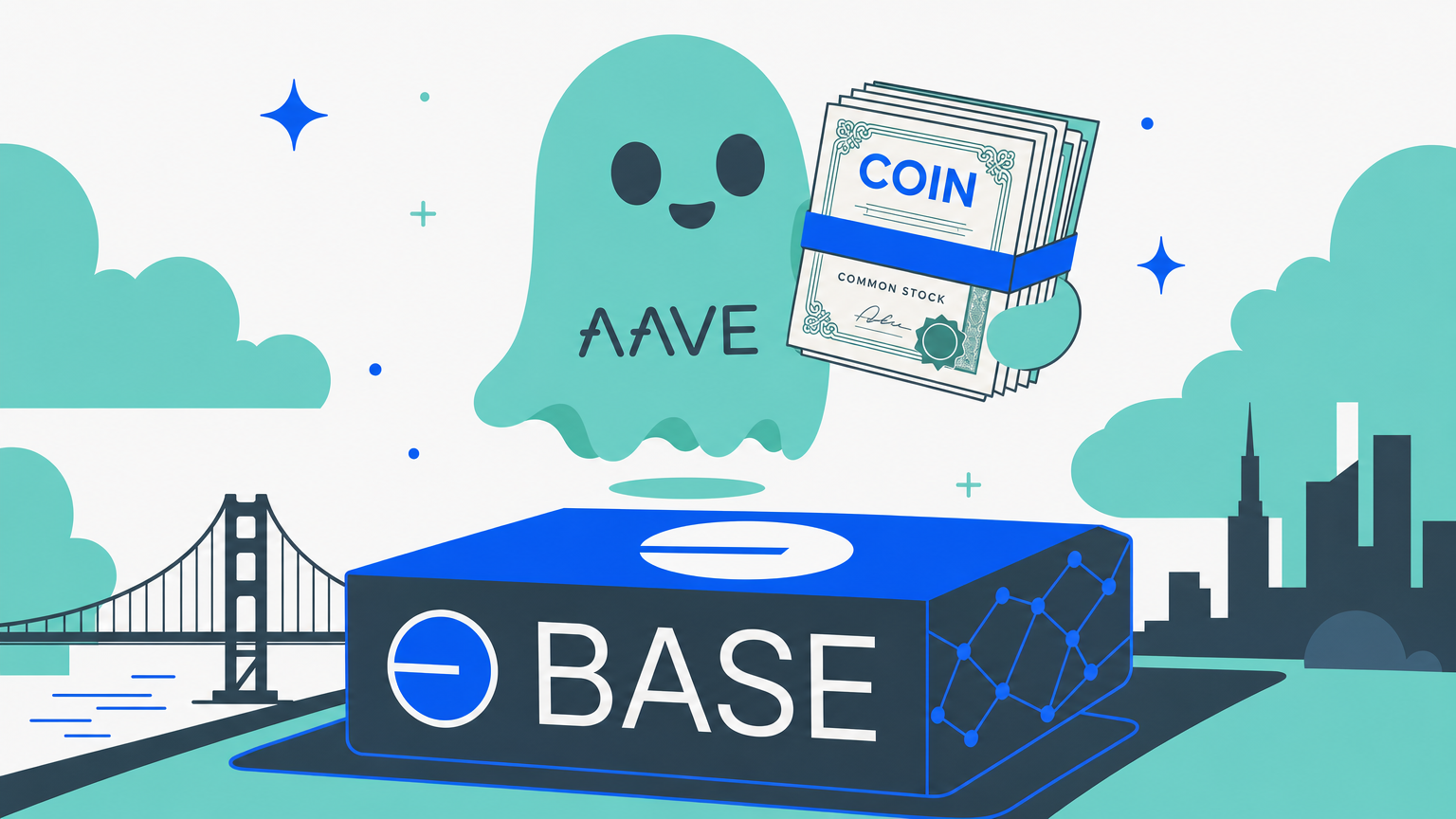
Seven Coinbase B20 tokenized equities are being assessed as collateral inside a dedicated Equities Hub on Aave V4 Base. The Aave governance forum assessment names AAPLc, AMZNc, GOOGLc, METAc, MSFTc, NVDAc and TSLAc as the candidates. Post tokenized equity as collateral, borrow USDC — that’s the whole thing at launch.
The design is deliberately narrow, and the community is still working through risk parameters alongside the legal and technical conditions these assets carry before anything deploys on Base.
The underlying structure is worth reading closely. Each token is a certificate over shares held in segregated custody under a bare trust governed by ADGM law. The FSRA approved the public prospectus on August 4, 2026. That approval expires August 3, 2027 — 364 days before new securities can’t be issued unless the prospectus gets renewed. That’s the clearest hard deadline in this record.
The prospectus classifies these securities as “Certificates representing certain Financial Instruments” under paragraph 92 of Schedule 1 of FSMR. Unvested securities get a different classification entirely: “Rights to or interests in investments” under paragraph 98 of the same schedule. The assessment flags the gap between those two classifications as among the questions still to be resolved.
Several distinct entities touch this collateral. Coinbase Onchain SPV Ltd is described in the assessment as an “Unregulated SPV” with no employees. Onchain Marketplace Ltd holds FSRA authorization for Arranging Deals in Investments and Providing Custody, restricted to operating a Central Securities Depositary. Alpaca Securities LLC is an SEC-registered broker-dealer, FINRA and SIPC member.
The trust structure is built to keep deposited assets separate. A Deed Poll and Declaration of Trust dated August 4, 2026 establishes two trusts — one for Registered Owners, one for Unvested Holders. For NVIDIA-linked securities specifically, deposited NVIDIA shares and related proceeds are segregated from the Trustee’s proprietary assets; Alpaca must hold that property on trust for the Trustee, separately from Alpaca’s own assets and, so far as practicable, from other clients’ assets.
These securities aren’t listed anywhere. Not admitted to trading on any exchange or trading facility, and the assessment says that’s not expected to change. Transfer and trading happen exclusively through DeFi Markets, which the assessment notes are currently unregulated in the ADGM.
U.S. access is blocked. The securities are unregistered under the U.S. Securities Act and may not be acquired, held, sold, transferred or delivered in the United States or to, or for the account or benefit of, a “U.S. Person.” Primary offers are made in the ADGM exclusively to Authorised Participants classified as Professional Clients or Market Counterparties; secondary markets let those participants make securities available in DeFi Markets, including to retail investors. Enforcement of the U.S. restrictions relies on smart-contract embeddings, blockchain analytics and freeze powers, and the assessment acknowledges those tools have limits. For an Aave deployment that’s not abstract: collateral eligibility binds lenders and borrowers to transfer controls layered on top of the usual price and liquidation mechanics.
Every secondary acquirer enters the position of an Unvested Holder. Until vesting, that holder has no redemption, voting or information rights. The assessment leaves open whether a given holder would satisfy the Vesting Conditions, how long processing would take, and whether a liquidator, enforcement agent or a lending protocol’s liquidation contract would even be permitted to vest.
Work through the concrete scenario: a borrower posts one of the seven tokens, draws down USDC, but the token’s transferability, vesting status and jurisdictional restrictions all remain embedded in the position’s operational risk. Standard DeFi liquidation flows may run straight into those restrictions and not resolve automatically.
Community review is now focused on whether the structure the FSRA approved on August 4 can actually function as collateral on Aave V4 Base. August 3, 2027 is when leaving that unanswered gets costly.

Marcus Feld
Marcus Feld is CoinScoop's DeFi and on-chain analyst. He digs into L2 activity, stablecoin flows and protocol revenue, translating raw chain data into plain-English calls.