


ECB’s Schnabel calls for central bank money to go on-chain
ECB Executive Board Member Isabel Schnabel advocated for central banks to put their own money on distributed ledgers in an August 28 speech at Jackson Hole.

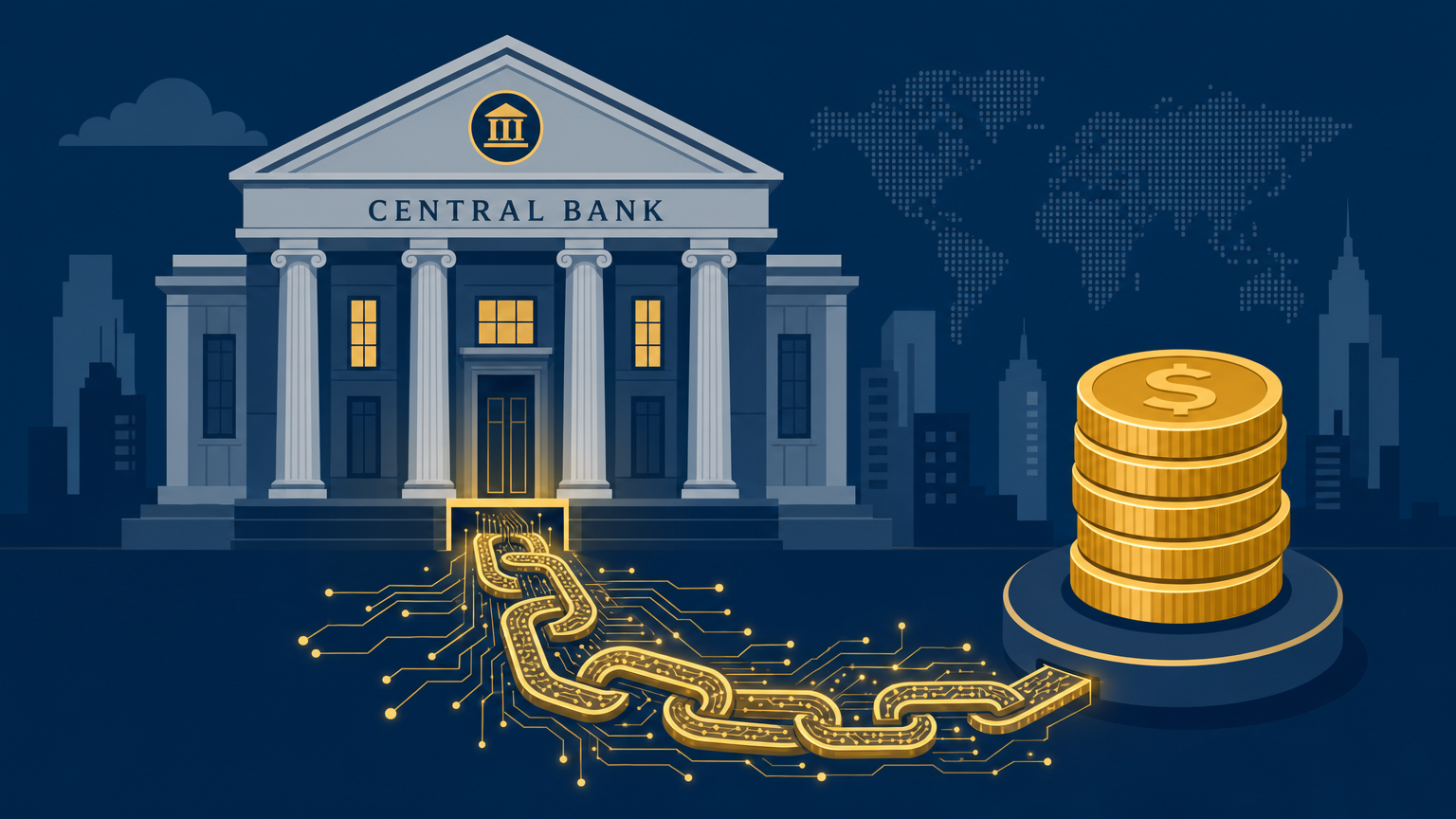
Isabel Schnabel, a Member of the Executive Board of the ECB, used her August 28, 2026 speech at the Jackson Hole Economic Policy Symposium to argue that central banks should put their own money on distributed ledgers. The speech, titled “Financial Innovation: Implications for Payments and Policy,” is the primary document.
Her position is explicit. “Here I will suggest that central banks should embrace DLT and go on-chain themselves,” Schnabel said. The statement places direct central-bank participation inside the ECB’s discussion of tokenized finance, rather than leaving settlement in tokenized markets entirely to private issuers or intermediary systems.
The settlement asset comes first
Schnabel’s speech discussed Darrell Duffie’s paper “Tokenized finance and the perimeter of central banking.” It frames wholesale-finance tokenization as one of DLT’s most promising applications: financial assets and money can be represented as digital tokens on programmable platforms.
The constraint is settlement. The take-off of tokenized finance has been partly hindered by the absence of a safe settlement asset, and the speech says a trusted settlement asset is a prerequisite for capturing tokenization’s benefits. In the modern two-tier monetary structure, central banks issue central bank money while commercial banks issue money-like claims.
Central bank reserves do not carry credit or liquidity risk. Schnabel also sets a second requirement for a settlement asset: supply must expand elastically. That matters in a stressed market, when settlement demand can rise and a fixed or privately controlled liquidity pool may not meet it.
Her conclusion puts stablecoins below central bank money in that hierarchy. “My conclusion is very much in line with Darrell’s: stablecoins are dominated by settlement solutions based on central bank money, reflecting in part the unique ability of central banks to elastically provide liquidity,” Schnabel said at Jackson Hole.
Three routes, one native option
Duffie’s paper sets out three possible ways for central bank money to operate in a tokenized environment: central banks could issue tokenized reserves directly; existing payment systems could be linked to tokenized platforms; or a private intermediary could sit between the two systems.
Only the first option makes central bank reserves natively tokenized. The arithmetic is simple: one of the paper’s three options, or 1 ÷ 3 = 33.3%, directly places reserves on-chain. The other two connect tokenized finance to existing infrastructure or route access through a private intermediary.
The speech does not specify whether that would mean a single shared ledger or a central-bank-operated ledger connected to other systems. It also gives no implementation timeline. The immediate consequence is therefore strategic rather than operational: market participants have a clear statement of preference, but no deployment date or technical architecture to trade around.
What on-chain central money would do
Schnabel says bringing central bank money on-chain would preserve its role as the foundation of settlement. It would also allow central banks to use ledger programmability in monetary policy implementation, collateral management and liquidity provision, with financial stability among the stated aims.
Tokenization supplies two properties behind that argument. Atomicity means linked transactions settle together or fail together. Programmability makes settlement conditional on rules that execute automatically. Those features could change how assets and settlement cash interact inside a transaction, provided the central-bank money is available on the same programmable environment.
The Eurosystem already has a delivery-versus-payment mechanism for domestic securities trades through TARGET2-Securities, or T2S. Schnabel’s speech presents tokenized settlement as an extension of the capabilities available on programmable platforms, rather than as the first time securities delivery and payment have been linked.
Repo transactions are one concrete use case in the speech. Programmable settlement through tokenization can reduce messaging, reconciliation and manual interventions in repo trades. The parties most directly affected would be institutions handling those settlement steps, while protocols supplying tokenized collateral or transaction logic would depend on how central bank money becomes accessible.
More access, but no blank cheque
The speech also identifies possible market-structure effects. Tokenization can lower barriers to entry for infrastructure providers and firms, with France’s “Lightning Stock Exchange” (Lise) given as an example. It can also enable fractional ownership, allowing investors to gain exposure to assets such as gold bars or real estate with smaller investments.
Europe’s financial infrastructure is fragmented along national lines, and Schnabel says tokenization could help integrate it. That creates a possible benefit for firms operating across those divisions, but the speech keeps the settlement asset at the center of the condition: tokenization’s gains depend on access to a trusted form of money.
The historical case in the speech is the Federal Reserve Act of 1913. Schnabel says it was motivated by difficulty ensuring an elastic currency supply under the National Banking System; she also refers to the 1907 banking panic as an example of liquidity strain when money supply could not expand smoothly. Modern central banks, by contrast, can expand liquidity elastically to counter financial stress.
For European tokenized-finance protocols and institutions, the practical takeaway is specific. Stablecoins remain part of the payment mix in Schnabel’s framing, but central bank money is the preferred settlement foundation. Firms that depend on private stablecoins alone could face a less central role if the ECB follows through with direct tokenized reserves; firms building around programmable settlement, collateral and liquidity tools could benefit from the proposed architecture.
What happens next remains open. Schnabel’s August 28 speech establishes the ECB’s argument for central banks to go on-chain, while leaving the ledger design, access model and timing for any tokenized-reserve implementation unspecified.

Nadia Rahman
Nadia Rahman is CoinScoop's Markets Editor. She covers Bitcoin, macro liquidity and the spot-ETF complex, and previously reported on rates and FX for a global newswire.